Human Rights Day PSD Templates: Design for Impact
When December 10th rolls around, the pressure to create meaningful content is real. You need visuals that don’t just look good, but actually convey the gravity and hope of Human Rights Day. Generic stock photos often fall flat, lacking the specific symbolism required for such a serious observance. This is where having a dedicated design asset library becomes essential. I’ve been working with the Human Rights Day PSD Banner Design Template Bundle, and it changes the workflow significantly. It’s not just about having a file to open; it’s about having a structured foundation for advocacy that respects the subject matter while giving you full creative control.
The Anatomy of Advocacy: Understanding the Visual Language
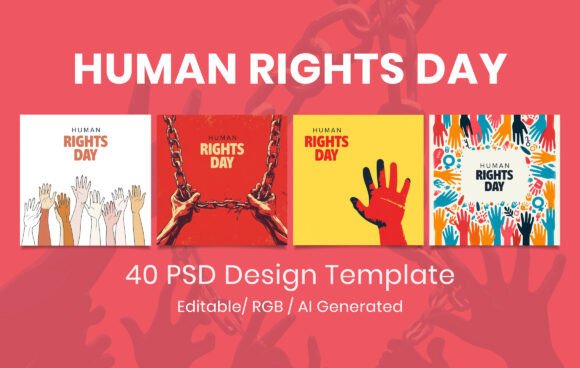
The visual style of these templates relies on a specific balance between urgency and dignity. Unlike a standard holiday sale banner, these designs avoid clutter. They utilize negative space effectively to let the message breathe. You will notice a prevalence of strong sans serif typography—usually something with high legibility and modern weight—paired with iconography that suggests unity, such as interconnected hands or abstract globe motifs.
From a technical standpoint, the "personality" of these files is structured and professional. They are built using smart objects in Photoshop, which means the heavy lifting of alignment and layer management is already done. The color palettes are typically anchored in deep blues, slate greys, and vibrant accents like gold or teal. These colors aren't arbitrary; they are chosen to evoke trust and optimism. As a designer, you aren't just downloading a picture; you are adopting a visual system designed to communicate complex ideas like justice and equality quickly.
Practical Applications: Beyond the Social Feed
While social media graphics are the most obvious use case, limiting these templates to an Instagram story would be a mistake. The bundle includes high-resolution JPEGs (300 DPI), which opens up a world of print possibilities. I have seen these assets used effectively in local community centers for event flyers and in corporate lobbies for digital signage during awareness weeks.
For educational content, the templates serve as excellent starting points for infographics. The clear hierarchy established in the original design helps in organizing data points about human rights statistics. If you are a nonprofit organization or an educator, the ability to customize text and imagery means you can tailor the message to specific regional issues without violating the integrity of the original design. It works equally well for a simple A4 handout as it does for a wide-format banner at a rally.
Strategic Customization: Making the Design Yours
The real value of the PSD files lies in their editability. A common mistake I see is users simply swapping out the text and hitting "save." To truly make an impact, you need to consider how the template interacts with your existing brand identity. If you are a small business owner promoting a charity drive, you shouldn't just use the default colors. Instead, sample your brand’s primary color and apply it to the background or key accent elements within the template.
When it comes to typography, while the templates come with suggested fonts, don't be afraid to experiment with font pairing. If the template uses a bold sans serif for the headline, consider if your brand’s specific serif font works for the subheadline. However, be cautious with readability. Human rights messaging needs to be accessible to everyone. Avoid overly decorative script fonts for the main message. Stick to clean, modern typography that ensures the text is readable on both a mobile screen and a printed poster from ten feet away.
Key Elements to Edit for Maximum Impact
- Imagery: Swap the AI-generated symbols of peace for photos of your specific community or team if the context allows for a more personal touch.
- Color Schemes: Adjust the contrast. If you are printing, ensure the background color isn't too dark to save on ink, or conversely, ensure digital versions have enough contrast for accessibility standards.
- Call to Action: Most templates have a placeholder for a URL or date. Ensure this is prominent. If you are driving traffic to a petition or donation page, this element needs to be the focal point.
Technical Considerations for Professional Results
Working with premium design assets requires a bit of technical diligence. Before you start customizing, check the licensing. Even if a font is included in the PSD, verify if it is free for commercial use or if you need a separate license for your specific project. This is crucial for maintaining professionalism and avoiding legal headaches later.
Another aspect to consider is the file format. While the PSDs are great for editing, the provided 300 DPI JPEGs are your go-to for print-ready designs. When sending files to a printer, always flatten your layers and export at the highest quality. For web use, optimize the files to balance load times with visual clarity. You don't want a grainy, pixelated banner on a high-resolution 4K monitor, but you also don't want a 10MB image slowing down your landing page.
Evaluating Project Fit
Ask yourself: Does the visual weight of the template match the tone of my message? If you are addressing a somber topic like refugee crises, a template with bright, celebratory confetti might not be appropriate, even if it says "Human Rights." Look for the templates that offer a more muted, serious aesthetic. Conversely, if you are celebrating a victory for equality, the more vibrant, dynamic layouts will serve you better. The bundle offers variety to cover these different emotional beats, but selecting the right one is a strategic decision, not just an aesthetic one.
Ultimately, these templates are tools. They provide the structure and the visual language, but the context comes from you. By leveraging the editable nature of the PSD files and paying attention to the details of typography and color, you can create campaigns that don't just look professional, but genuinely resonate with your audience and honor the significance of the day.